











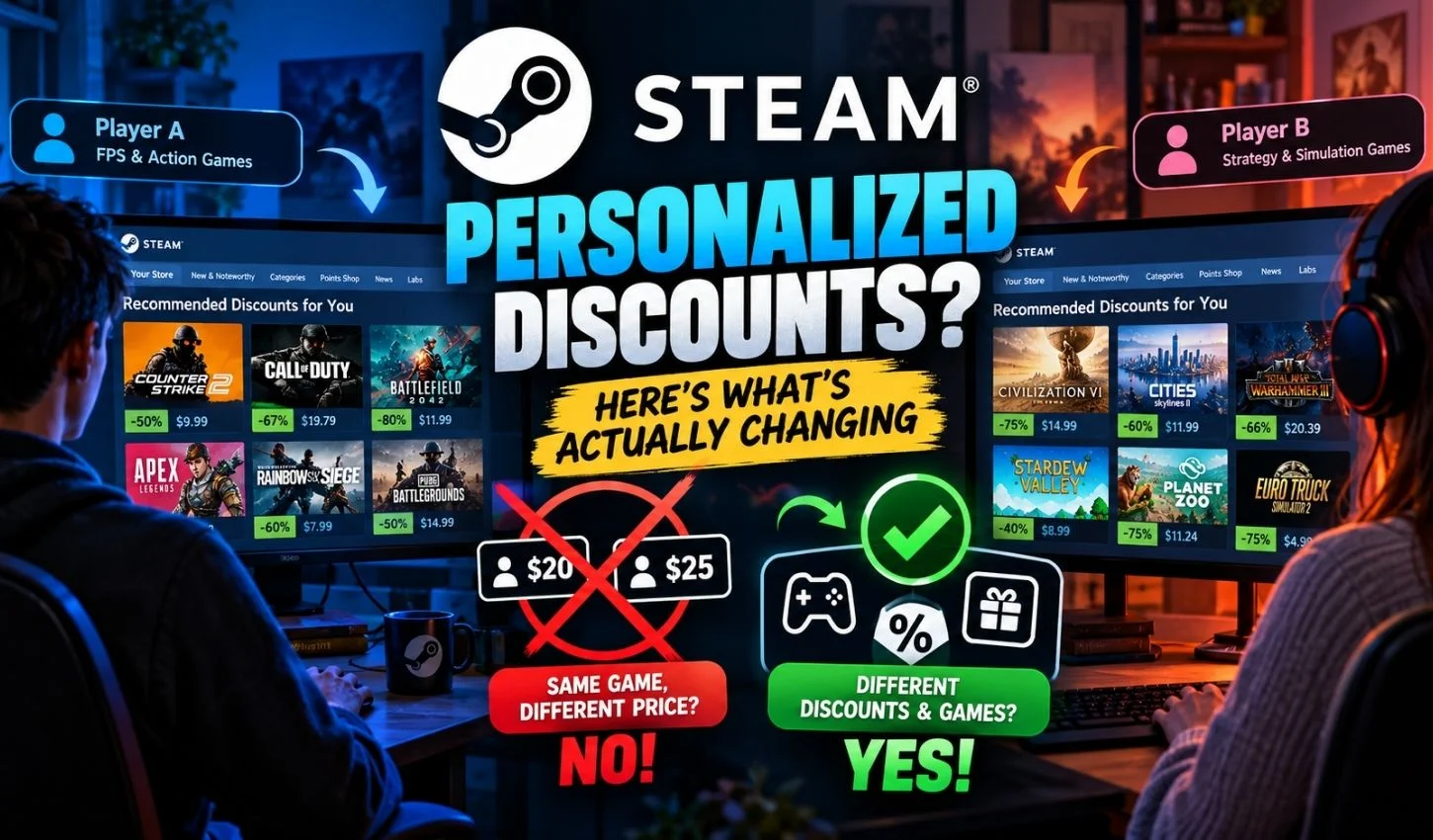
Is Steam Introducing Personalized Discounts? Here’s What’s Actually Changing
Recent reports about changes to Steam’s discount system have caught the attention of PC gamers. Headlines suggesting that “Steam prices will become personalized for each user” have also raised an important question:
Could the same game soon have a different price depending on who is viewing it?
The answer, at least based on what Valve has announced, is no.
Steam is moving toward greater personalization, but the main change is about which discounts, games, and events are shown to each user — not setting a unique price for every individual player.
🎮 Is Steam Introducing Personalized Pricing?
Not in the way many players might think.
The announced changes focus on making Steam’s store experience and discount discovery more personalized.
This means two Steam users could open the store and see very different discounted games.
For example:
👤 Player A regularly plays competitive shooters and FPS games. Steam may prioritize discounts on similar titles.
👤 Player B mostly plays strategy and simulation games. Steam may instead highlight deals from those categories.
However, if both players visit the same game's store page under the same regional pricing conditions, the system does not mean that Steam will automatically charge each player a different personalized price.
💰 One Player Won’t Simply See $20 While Another Sees $25
This is where much of the confusion surrounding the announcement comes from.
The announced system does not currently mean:
❌ Increasing prices based on how much a particular user spends.
❌ Selling the same game to different individuals at individually calculated prices.
❌ Charging frequent Steam customers more because they are more likely to purchase a game.
Instead, it means:
✅ Showing users discounts, games and events that are more relevant to their interests.
In other words, the personalization is primarily about what Steam shows you, not creating an individual price specifically for you.
🔍 Why Is Steam Making This Change?
Steam contains an enormous number of games, promotions and discounts.
As a result, it is practically impossible for an individual player to discover every promotion available on the platform.
Valve has been experimenting with personalization to improve game discovery and expose players to a wider variety of titles.
Rather than presenting essentially the same promotional storefront to everyone, Steam can increasingly determine which deals are likely to be relevant to each user.
Your Steam store could therefore become significantly more personalized based on the games and categories that interest you.
📅 When Will the New Steam System Arrive?
Valve has indicated that work on its personalized discount and event experience is continuing, with broader implementation planned for early 2027.
Steam users may therefore begin seeing increasingly personalized selections of promotions, discounts and events as the system develops.
🛒 What About Steam's Regional Pricing?
Regional pricing is a separate issue.
Publishers and developers can set prices for supported currencies and regions, while Steam can also provide regional pricing recommendations.
This already means that the same game can cost different amounts in different countries or regions.
However, regional pricing and individual personalized pricing are not the same thing.
A game being cheaper in one region than another does not mean Steam is calculating a different price for every individual account.
🚀 So, What Is Actually Changing?
Claims that “Steam will now show every user a different price” can give the wrong impression.
The change is better summarized like this:
Instead of showing every player the same selection of discounts, Steam will increasingly personalize which deals and games appear based on what each player is likely to be interested in.
Your friend could therefore open Steam and see a completely different collection of discounted games from the ones appearing on your store page.
🎮 The price may be the same — but the deals Steam chooses to show you could become much more personal.